Complete School Communication System Requirements in Pakistan
SMS, WhatsApp Messaging & Push Notifications — Policies, Compliance & Proven Solutions
Modern schools operate in a highly connected environment where communication with parents, teachers and administration is not a luxury — it is a core operational necessity.
Understanding the legal, technical and regulatory framework behind school communication systems is essential for every director and institution owner.
This document presents a clear, professional explanation of how major communication channels operate in Pakistan and what conditions are required for their successful implementation.
Lecture 1 — Bulk SMS via SIM: Understanding the Real Requirements
Bulk SMS remains one of the most widely used communication channels in education.
However, many institutions believe that their SMS systems have failed, when in reality the failure is not technical — it is regulatory.
To understand this, one must first understand the complete communication pipeline.
The Complete Bulk SMS Communication Pipeline
| Pipeline Component |
Responsibility |
Operational Status |
| School Software Platform |
VB.NET application that generates, schedules and sends SMS messages |
Fully Functional |
| Telecom Network Infrastructure |
National mobile routing systems governed by PTA |
Restricted without compliance |
From the software perspective, the school's messaging platform is operating correctly.
Messages are created, processed and transmitted efficiently.
There is no technical fault within the application.
Why SMS Delivery Stops Without PTA Authorization
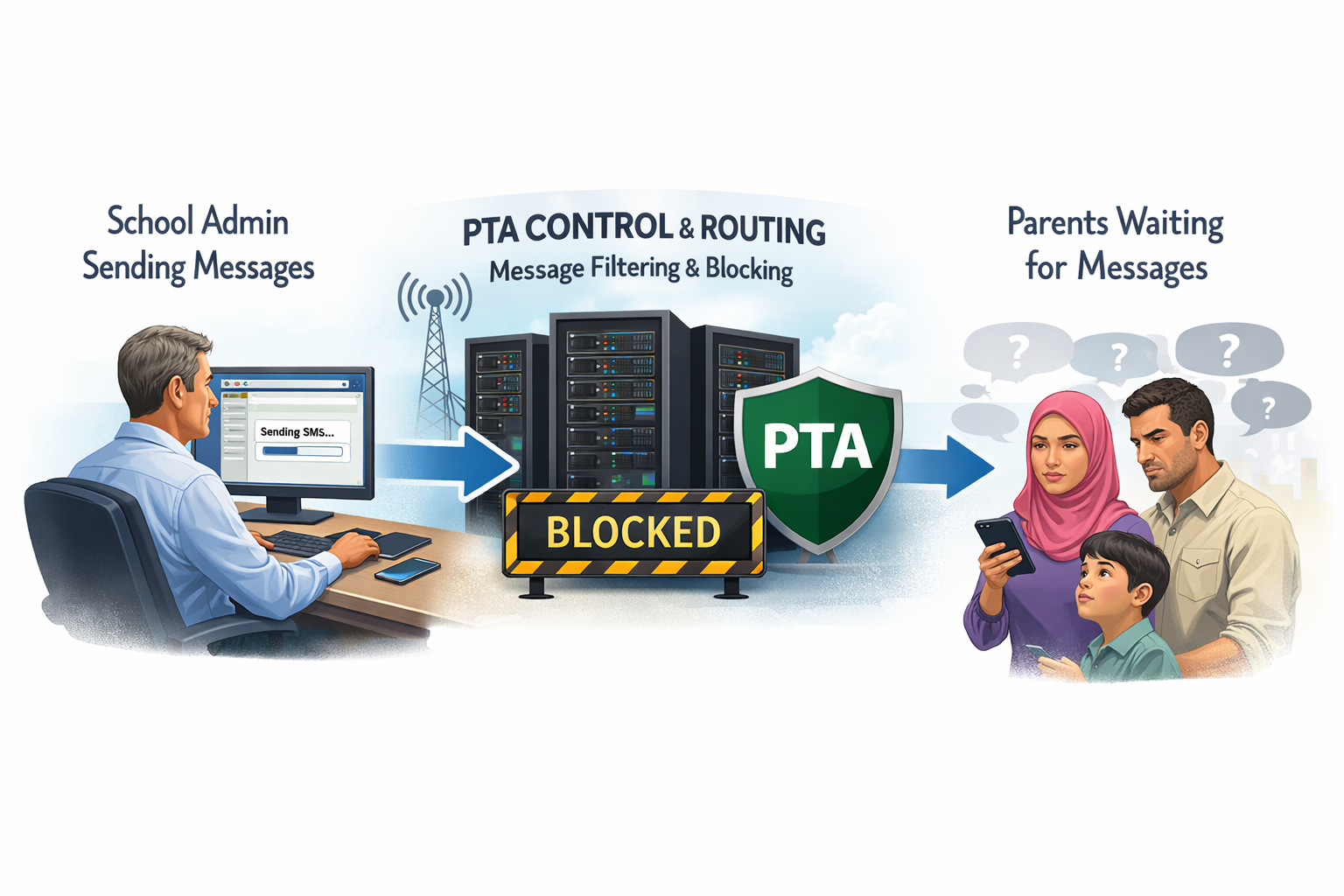
All SMS traffic in Pakistan is regulated by the Pakistan Telecommunication Authority (PTA).
This is not an optional requirement.
Without official authorization and registration, mobile operators are legally obligated to block bulk SMS traffic.
Therefore, message delivery fails not because of the software, but because the national telecom network itself refuses unauthorized traffic.
Global Regulatory Alignment
Pakistan’s telecom governance model follows international standards used by leading regulators worldwide.
Countries such as the United States (FCC), the United Kingdom (Ofcom), India (TRAI) and the global GSMA framework operate under the same principles.
These policies exist to protect citizens, networks and national infrastructure from misuse.
Why PTA Enforces These Regulations
- To prevent large-scale spam campaigns
- To stop financial fraud and identity scams
- To control misuse of SIM-based communication systems
- To maintain stability and security of national telecom networks
- To ensure legal traceability of mass communications
Mandatory Compliance Requirements for Schools
- Formal registration of the institution with a PTA-authorized SMS aggregator
- Approval of sender identity and message content
- Activation of an official bulk messaging route
- Payment of licensing and volume-based usage fees
- Continuous compliance monitoring and reporting
If any of these requirements are missing, the telecom network automatically blocks SMS delivery — regardless of how advanced the software is.
When Will Bulk SMS Work 100% Successfully?
The moment a school completes PTA compliance and activates an authorized bulk messaging route, the same VB.NET system immediately begins delivering messages with full reliability.
No software modification is required. No redevelopment is required.
The entire system becomes stable, predictable and scalable.
Executive Conclusion
Bulk SMS failure is not a technology problem.
It is a regulatory compliance requirement.
Once compliance is fulfilled, bulk SMS becomes a powerful and dependable communication engine for any educational institution.
Lecture 2 — Why WhatsApp Messaging Appears to Fail
After SMS, many schools attempt to use WhatsApp for large-scale communication.
When messages stop delivering, the immediate assumption is that the system or software is faulty.
In reality, WhatsApp operates under one of the strictest communication policy frameworks in the world.
Once again, the failure is not technical — it is regulatory and contractual.
The WhatsApp Communication Pipeline
| Pipeline Component |
Responsibility |
Operational Status |
| School Messaging Software |
VB.NET WhatsApp integration that composes and sends messages |
100% Functional |
| WhatsApp Platform & Policy Engine |
Global messaging infrastructure governed by WhatsApp policies |
Strictly Controlled |
From the technical side, the school's WhatsApp messaging module is fully tested and functional.
Messages are generated, queued and transmitted correctly.
There is no defect in the software.
Delivery is determined entirely by WhatsApp’s internal compliance and enforcement systems.
Why WhatsApp Enforces Strict Messaging Rules
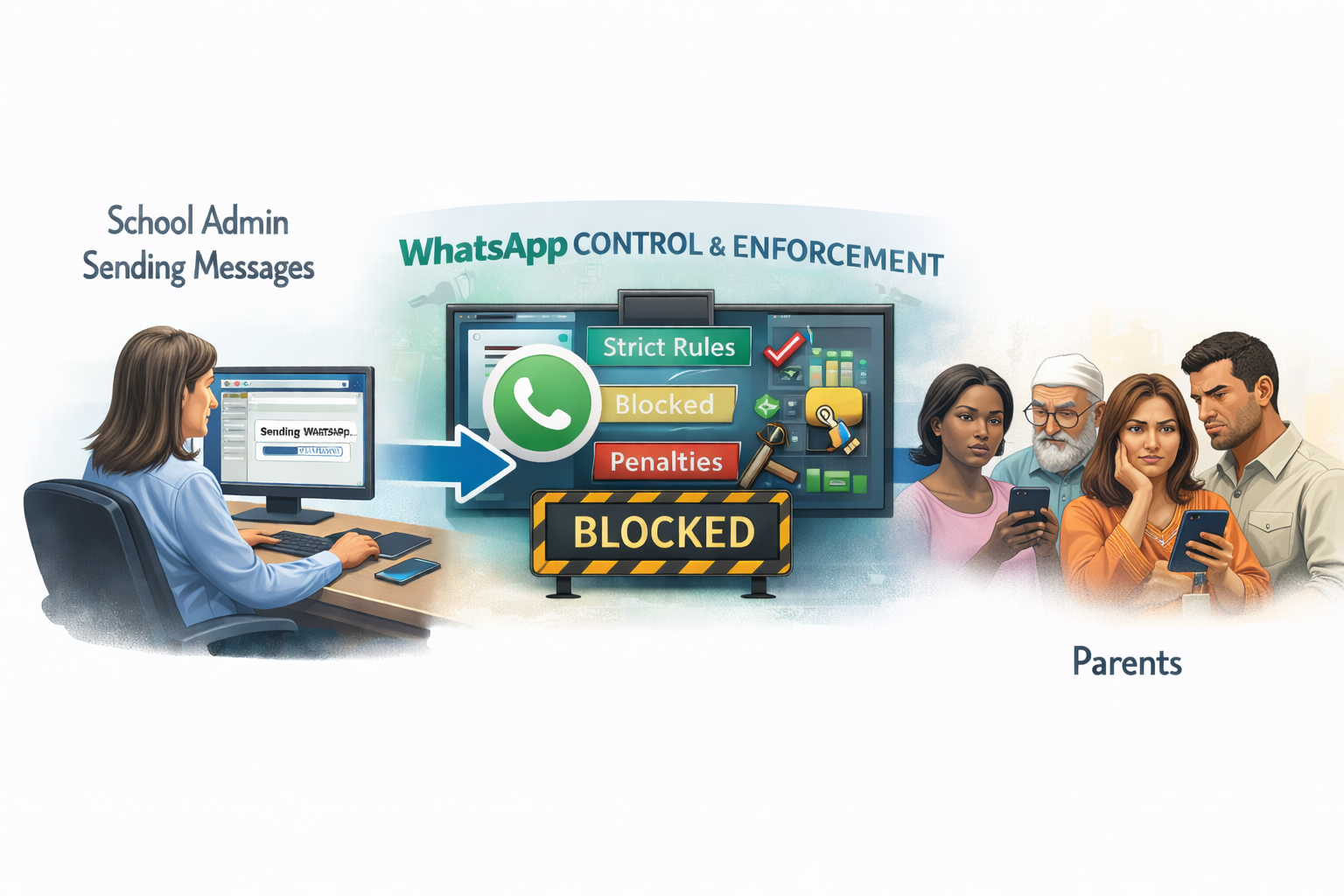
WhatsApp is a global communication platform used by billions of users.
To protect users from abuse, spam and fraud, WhatsApp enforces extremely strict business messaging policies.
These rules are non-negotiable and are applied automatically by WhatsApp’s AI and monitoring systems.
Core WhatsApp Business Messaging Requirements
- Registration of the business through the official WhatsApp Business Platform
- Verification of the organization’s identity
- Approval of messaging templates
- Use of approved API providers only
- Explicit user consent (opt-in) before messaging
- High quality rating based on user interaction and feedback
What Causes WhatsApp to Block or Restrict Messaging
- Sending bulk messages without proper registration
- Messaging users who have not provided consent
- Sending messages to invalid or inactive numbers
- High report or block rate from recipients
- Using unofficial or unauthorized messaging routes
- Failure to maintain a healthy quality score
When these conditions are violated, WhatsApp does not simply stop message delivery —
it actively penalizes the sender by reducing message throughput, restricting the account,
or permanently banning the business number.
The Financial & Compliance Commitment
WhatsApp business messaging is not a free service for large-scale communication.
Organizations must engage official API providers and pay per message or per conversation.
These fees support infrastructure, compliance enforcement and user protection mechanisms.
Executive Summary
WhatsApp failure is not a software problem.
It is a compliance and policy enforcement issue.
When a school follows WhatsApp’s business policies, completes verification,
uses approved messaging routes and maintains high-quality standards,
the same VB.NET system delivers messages reliably and at scale.
Lecture 3 — Push Notifications: The Success Model
Unlike SMS and WhatsApp systems, push notifications — when implemented correctly — offer one of the most reliable and scalable communication channels schools can use today. With push alerts, the school’s server sends messages, and the delivery is managed by Google’s push infrastructure, ensuring prompt and efficient distribution to parents’ devices.
The Push Notification Pipeline
| Pipeline Component |
Responsibility |
Operational Status |
| School Server & VB.NET App |
Generates alerts and event triggers |
100% Functional |
| Push Messaging Platform (Google) |
Routes notifications to devices globally |
Reliable & Scalable |
| Parents’ Devices |
Receives and displays alerts when app is installed |
Delivered Instantly |
Push notifications rely on a global mobile messaging service provided by Google called Firebase Cloud Messaging (FCM), used for both Android and cross-platform alerts. This system is designed to be highly reliable and cost-efficient, without the regulatory barriers found with SMS or WhatsApp business messaging.
Why Push Notifications Don’t “Fail”
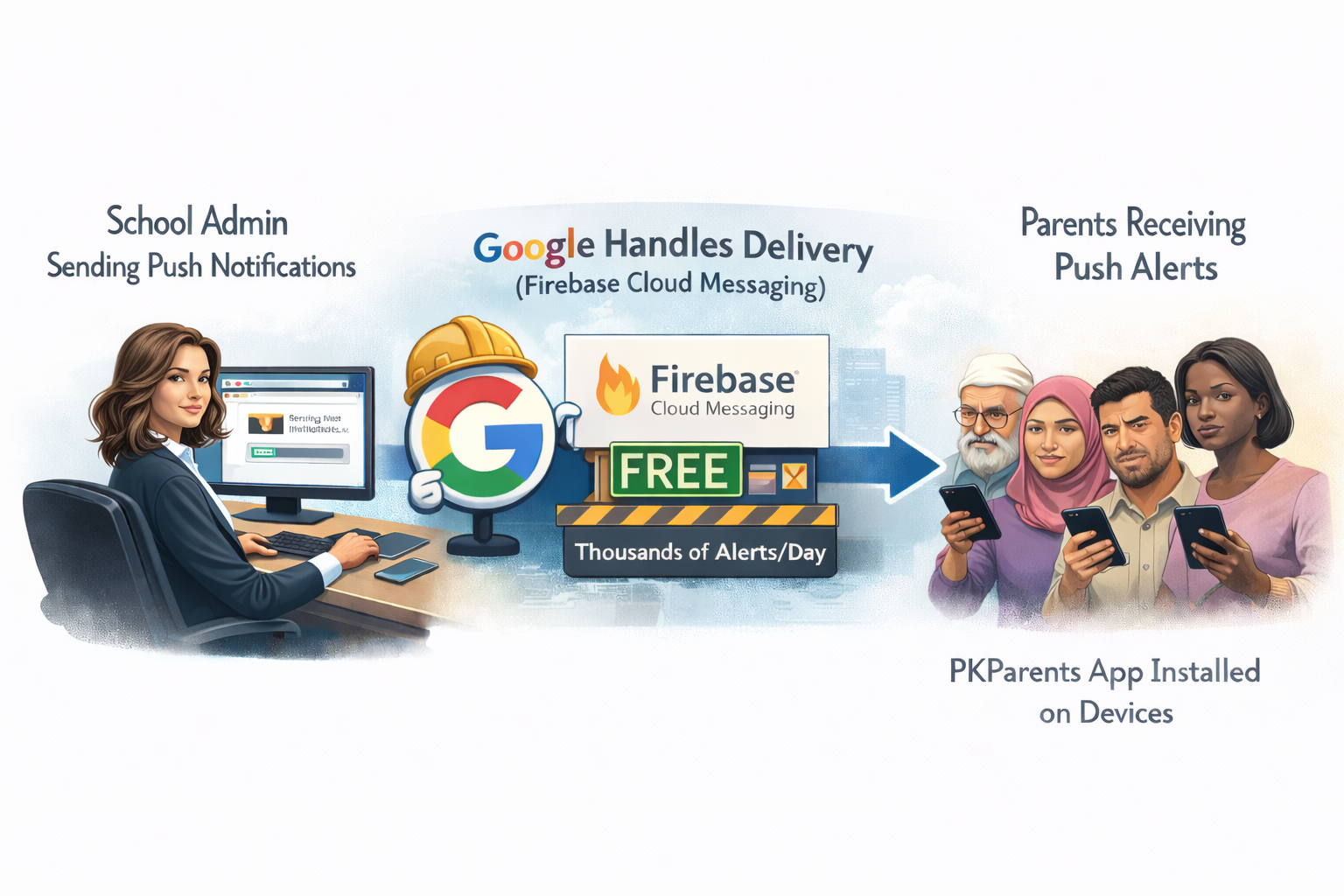
Push messaging does not suffer from the same policy restrictions as SMS or WhatsApp because it is part of the app ecosystem itself and not a regulated telecom service. When parents install the school’s app — such as PKParents — and grant notification permission, push notifications can be delivered by Google’s infrastructure rapidly and securely.
This means that for push alerts to work reliably, the PKParents app must be installed on parents’ devices and notifications must be enabled — otherwise the alerts cannot reach the end user.
How Google’s Push Messaging Works
Push notifications are sent through Firebase Cloud Messaging, which handles delivery across Android, iOS and web platforms. Google’s system ensures that messages are:
- Delivered through optimized channels with minimal battery and data usage
- Handled efficiently even when the app is in the background
- Managed securely and globally at scale without additional licensing
Free Usage and Quotas
One of the strongest advantages of push notifications is that they operate on Google’s global
Firebase Cloud Messaging (FCM) infrastructure and do not follow the commercial charging model
of SMS or WhatsApp business messaging.
For normal school operations, push notifications can be sent in very high volume without
direct per-message costs.
There is no strict daily limit for how many push notifications a school can send.
Google manages the delivery through its cloud network and automatically balances traffic
to ensure stability and performance.
For school usage — attendance alerts, announcements, reminders, exam updates and emergency notices —
the service easily supports thousands of messages per day without financial barriers.
At a technical level, Google applies background traffic management to protect its infrastructure,
but these controls do not interfere with legitimate school communication and remain invisible
during normal operations.
Best Practices for Reliable Delivery
- Use high-priority notifications for time-sensitive alerts so that they deliver promptly even in low-power modes.
- Ensure devices are registered correctly with FCM tokens in your server database
- Include fallback logic for handling undelivered or expired tokens
- Batch messages efficiently to avoid transient rate limits on massive bursts
Executive Summary
Push notifications represent the most dependable communication channel for modern school systems because:
- They are free to use at scale through Google’s Firebase Cloud Messaging service
- There is no regulatory barrier like SMS or WhatsApp compliance
- They deliver instantly when the app is installed and notifications are enabled
However, the PKParents app must be installed on the parents’ devices, and notification permission must be granted — only then will push alerts be delivered as intended.
Final Conclusion — A Complete Communication Strategy for Schools
Modern school communication is not controlled by software alone. It is governed by a combination of
technology, international policies, regulatory frameworks and platform rules.
When these requirements are clearly understood and respected, a school gains a stable, scalable and
future-ready communication ecosystem.
Bulk SMS works when PTA compliance and licensed routes are in place.
WhatsApp messaging works when official business policies, approvals and quality standards are respected.
Push notifications work reliably and economically when the PKParents application is installed on parents’ devices and managed through Google’s global infrastructure.
Together, these three channels form a complete, compliant and powerful communication strategy for any modern educational institution.
Frequently Asked Questions (FAQs)
Why did our Bulk SMS system fail?
It did not fail technically. SMS delivery stopped because PTA regulations require registration, approval and licensing.
Without these, mobile operators automatically block bulk traffic.
Why did WhatsApp messaging stop working?
WhatsApp enforces strict global policies. Messaging without official business approval, user consent,
or proper quality control results in throttling, restrictions or permanent bans.
Why are Push Notifications different?
Push notifications operate inside the mobile application ecosystem and are delivered through Google’s
Firebase Cloud Messaging platform. They do not require telecom licensing and provide high-volume delivery at minimal cost.
Is PKParents app installation mandatory?
Yes. Without the PKParents app installed on parents’ devices — and notifications enabled —
push alerts cannot be delivered. The app is the foundation of the push communication model.
Which channel is the most reliable for daily school communication?
Push notifications provide the highest reliability, lowest operational cost and fastest delivery.
SMS and WhatsApp remain valuable as supplementary channels when their compliance requirements are fulfilled.
What is the recommended communication model for schools?
A hybrid model:
Push notifications as the primary channel,
SMS and WhatsApp as secondary channels for redundancy and outreach.